Showing posts with label global health. Show all posts

Monday, September 17, 2018

New book "Factfulness" asserts that world is much better than most believe

This was originally published on Global Health TV on August 6, 2018.

I first saw Hans Rosling deliver a presentation on facts and fiction on global health in New York in 2010. Like many of his fans, I was swept away by his stunning visual presentations of data, his charming Nordic folksiness and his ability to shed light on some glaring misconceptions of global health and development that he has been working to rectify the last two decades.

He was shocked to discover that people get basic facts on population, health and development wrong, and not just the general public but also highly educated people, even at the World Economic Forum in Davos and Nobel laureates. So this Swedish professor of global health set out to educate people, primarily through his TED talks, which have been viewed more than 35 million times (check out “Let my dataset change your mindset” and “How not be ignorant about the world”), to such an extent that he became a nerdy global health rock star.

In September 2015, Hans and his son Ola Rosling and daughter-in-law Anna Rosling Rönnlund decided to write a book to explain why people do not see the world as it really is, and why we get so many basic facts so wrong. Five months later, he received a diagnosis of incurable pancreatic cancer, and was told he had two or three months to live. He threw himself into finishing this book to such an extent that he was going over printed copies of the latest draft from his hospital bed in the days before he died in February 2017.

Thursday, September 13, 2018

Trump's expansion of Global Gag Rule sows chaos in global health

One of Donald Trump’s first acts as U.S. president was the re-imposition of the Global Gag Rule (GGR), also called the Mexico City Policy, a policy that denies healthy options to women and girls, not just safe abortion and contraception but potentially all areas of global health. 

Trump changed its name to “Protecting Life in Global Health Assistance,” but most global health advocates call it the Global Gag Rule because it silences health providers from providing comprehensive reproductive health options to women and girls.

The global gag rule is a failed, outdated and deadly policy,” writes Serra Sippel, the president of the Center for Health and Gender Equity (CHANGE), in the comprehensive new report Prescribing Chaos in Global Health: The Global Gag Rule from 1984 to 2018.

“Throughout this report, CHANGE seeks to document the breadth of the GGR’s impacts on civil society and health systems. For example, CHANGE provides evidence that the GGR under President George W. Bush had consequences outside family planning programs, and that it adversely impacted a wider range of health services provided by foreign NGOs. Some of these impacts were mitigated when President Barack Obama rescinded the policy, but the harmful effects have been shown to linger, particularly as each iteration has become more oppressive, culminating now with the Trump GGR.” 

The policy is having exactly the effect the Trump Administration intended it to have – women are losing health services, programs are being down-sized or closed and advocacy work disrupted. Because of poor communication and miscommunication coming from the U.S. government and prime partners, the CHANGE report says, many organizations are over-interpreting the policy, and going further than they really need to go, out of fear of losing funding and alienating an important donor (the U.S. government).

Wednesday, April 4, 2018

For global health, 2017 was a year of progress, near triumphs and threats

A trained community health workers in Bangalore, India takes photos of an oral lesion with a mobile phone during an oral cancer screening. Cancer is growing everywhere in the world. Photo: Biocon Foundation, Courtesy of Photoshare.
This was originally published on Global Health TV on Jan. 2, 2018.

In looking back over my last 12 blog posts here at Global Health TV, it is clear that 2017 was a year of progress, near triumphs and threats to global health.

In September, I reported that great progress has been made against diseases and health conditions that kill us (like respiratory infections, diarrhea, neonatal preterm deaths and communicable diseases like AIDS and malaria) while new threats had emerged  that are generally less fatal — things like obesity and mental illness.

In particular, we have made progress against communicable diseases but now face a rising tide of non-communicable diseases (NCDs) like cancer, diabetes, hypertension and cardiovascular diseases, as I wrote at the beginning of 2017.  Cancer is growing almost everywhere in the world. For example, cervical cancer causes over 500,000 new cases every year, even though vaccination, early screening and treatment of precancerous lesions can prevent most cases.

Thursday, March 29, 2018

Dramatic global health improvements save lives but new threats emerge

This was originally published on the Global Health TV on September 26, 2017.

Over the last decade, we’ve made great progress against diseases and health conditions that can kill people, especially children under 5, but because of political and budget challenges, we risk backsliding on those gains. And we’re facing a tsunami from health issues that do not always kills us – namely, obesity, conflict and mental illness – but cause poor health.

Those are my take-aways from two major reports that came out this month, one tracking how we are doing against the Sustainability Development Goals, particularly in global health, and the other a scientific study focused solely on global health.

“Goalkeepers: The Stories Behind the Data 2017,” a report from the Bill & Melinda Gates Foundation, was aimed at last week’s United Nations General Assembly. To draw attention to the report, the Gateses held a high-profile event featuring former President Barack Obama. The report touts the many global health advances that have been made but also cautions about the risks of complacency.

Monday, March 26, 2018

Teaching brain surgery in Africa: Compelling book reveals neglected area of health

Dilan Ellegala (left), the central character in "A Surgeon in the Village," supervising brain surgery in Tanzania. Photo: Tony Bartelme

This was originally published on Global Health TV on August 3, 2017.

“In early 2010 Bill Hawkins, then executive editor of the Post and Courier in Charleston, South Carolina, told me, ‘I met this crazy brain surgeon who opened a guy’s head with a wire saw in Africa. Check him out. Maybe we’ll send you to Tanzania.’ Not many reporters get such an invitation, but thanks to Bill, I was soon on my way.’”

So writes Tony Bartelme in “A Surgeon in the Village: An American Doctor Teaches Brain Surgery in Africa,” an informative and highly engaging book about a neglected area of global health – the dearth of surgeons in low- and middle-income countries. The book, published in March, is based on hundreds of hours of interviews that the author conducted in the U.S. and during five trips to Tanzania between 2010 and 2015.

When I started reading this book, I approached it as an obligation – something I had to do to inform myself, and possibly my readers, about an area of global health I knew nothing about.

But to my great surprise, I not only found it informative, I enjoyed it. The book is written in short chapters and in more of a novelistic style than most pieces of non-fiction. What I thought would be a chore turned into a pleasure. Perhaps that is because Bartelme is an experienced journalist who knows how to tell a good yarn.

Thursday, March 22, 2018

Budget debates in US, UK could augur poorly for global health funding

This was originally published in Global Health TV on July 25, 2017.

Global health financing has not been in such jeopardy since the large investments in it started in 1991 – the year in which global health funding started an upward trajectory that moved higher in all but three years.
In particular, the rise of Donald Trump of the United States and Theresa May of the United Kingdom —the leaders of the two largest donor nations — have raised concerns about the prospects for development assistance broadly, and global health specifically.
In 2016, development assistance for health (DAH) reached $37.6 billion, eking out a miniscule 0.1% increase from 2015 that followed a pattern of little growth since 2010 (DAH grew 11.4% annually from 2000 to 2010 but only 1.8% since 2010), according to “Financing Global Health 2016,” published by the Institute for Health Metrics and Evaluation in April. DAH peaked at $38 billion in 2013, dropped to $36 billion in 2014 and has recovered slightly in the two subsequent years. This infographic provides a snapshot.
The U.S. and the U.K. have been the two top contributors to DAH but both countries have political environments that have called into question their future commitments to foreign aid and global health.

Monday, August 29, 2016

"Millions Saved" shows that global health programs can achieve success

This was originally published at Global Health TV on May 24, 2016.

If you are reading this article, you probably already believe in global health, and its ability to improve the quality of life and save lives. Every month we tell some of these stories here at Global Health TV.

But some people do not believe that global health programs work or, perhaps, are just indifferent to that fact. The Kaiser Family Foundation recently released a survey of the U.S. general public that showed that the visibility of U.S. global health effort are declining – only 36% have heard a lot or some about U.S. efforts in the past year, down from 57% in 2010.

That’s why books like “Millions Saved: New Cases of Proven Success in Global Health,” written by Amanda Glassman, Miriam Temin and a team at the Center for Global Development, are so important. They provide us with specific examples of global health success that they culled from more than 300 examples of rigorous impact evaluations, and explain why there were successful.

“Around the world, people are benefitting from a global health revolution,” wrote Glassman and Rachel Silverman, both of the CGD, in a blog of the British Medical Journal (BMJ). “More infants are surviving their first months of life; more children are growing and thriving; and more adults are living longer and healthier lives. This amazing worldwide transformation begs several questions: What, specifically, are we doing right? What are the policies and programs driving the global health revolution from the ground up? Or put more simply, what works in global health, and how do we know?”

Tuesday, December 29, 2015

The biggest global health stories of 2015, and one untold story

A billboard warning about Ebola in Bamako, Mali.
This was originally published on Global Health TV on December 17, 2015

There seemed to be a lot of good global health news in 2015, especially when compared to 2014, when Ebola was ravaging West Africa and scaring the rest of the world. In the last 12 months, Ebola has mostly passed, progress was made against malaria and AIDS and the climate deal in Paris raised hopes that less climate change could improve global health.  Here are what I consider some of the top global health stories of the year, not necessarily in order of priority:

Ebola on the Decline: A year ago, Ebola was raging. As of Dec. 16, there have been 11,315 deaths and 28,640 cases of Ebola. But Ebola has not disappeared entirely. It re-emerged in Liberia after having earlier been declared Ebola-free. Dr. David Nabarro, the UN special envoy on Ebola, said that he expects transmission in Guinea to finish before the end of 2015 and in Liberia in early 2016. Here’s an update on Ebola in an interview with Dr. Nabarro.

Thursday, December 17, 2015

How does global health fare in the Sustainability Development Goals?

This originally appeared on Global Health TV on Sept. 28, 2015.

Last weekend in New York City, world leaders formally approved the Sustainability Development Goals (SDGs), which will guide development efforts over the next 15 years. They replace the Millennium Development Goals (MDGs) that were signed in 2000 and expire on Dec. 31, 2015.

The MDGs were terrific for global health, both in raising money, and raising its profile on the global agenda.

Eight goals made up the MDGs, and three of them were entirely focused on health. In addition, two other goals included health-related targets. Eight (38%) of the 21 total MDG targets were health-related, and seven of those targets were numerical (i.e. reduce maternal mortality by three quarters).

Between 2000 and 2014, $228 billion was allocated to address the three health-related MDGs, according to the Institute for Health Metrics and Evaluation (IHME) 

More importantly than how much was raised, serious progress was made on many of these health fronts. For example, two weeks ago, the World Health Organization announced that malaria death rates have plunged by 60% since 2000 and that the malaria target to have halted and begun to reverse the incidence of malaria by 2015 has been met “convincingly.” Most people think the Target 1A to halve the proportion of people living on less than $1.25 has been met.

But where is health in the SDGs? The answer to that question contains both good and bad news for global health advocates.

Friday, August 28, 2015

Global health funding: Huge increases since 2000, but also huge disparities

This was originally published on Global Health TV on July 27, 2015.

As the end of the era of the Millennium Development Goals (MDGs) (2000-2015) draws near, we who work in global health can look back with some satisfaction at the $228 billion that was allocated to address the three health-related MDGs during that time.

Although spending grew rapidly in the first ten years, it was stagnant between 2010 and 2014, and actually decreased by 1.6% between 2013 and 2014. Global health funding in 2014 amounted to $36 billion in 2014 (of which $1 billion was for Ebola).

That information comes from Financing Global Health 2014: Shifts in Funding as the MDG Era Closes, the annual report of global health funding published last month by the Institute for Health Metrics and Evaluation (IHME).

And two weeks ago, the Kaiser Family Foundation and UNAIDS issued a report that showed that although there was only a slight increase in funding for HIV in low- and middle-income countries in 2014 (less than 2%), seven of 14 donor countries actually decreased funding despite the recent gains made against the epidemic.

Monday, January 5, 2015

The top 10 global health stories of 2014

This was originally published by Global Health TV on Dec. 22, 2014.

Ebola, the biggest global health story of the year, is one that no one could have predicted when the year dawned almost 12 months ago. It did something that few global health stories do: It entered the consciousness of the global public in an important way. Beyond Ebola, though, there was much to celebrate in 2014.

Ebola: That one word represented not only the biggest global health story of the year, but one of the biggest stories of the year, of any type. As of Dec. 17, the World Health Organization (WHO) reported 18,603 cases and 6,915 deaths. Late in the year, incidence was declining in Liberia, slowing in Sierra Leone and “fluctuating” in Guinea. Sierra Leone surpassed Liberia as the country with the most reported cases. As I wrote here on Global Health TV last month, Ebola has made the definitive case for stronger health systems and health workers in developing countries.

Thursday, November 13, 2014

General foreign aid and health aid are up but donors still not meeting targets

This blog was originally published by Global Health TV on Oct. 29, 2014.

After two years of declines, overseas development assistance (ODA) rebounded in 2013, but most donors have not met their commitments and are not sending a high enough proportion of their aid to the poorest countries, according to the ONE Campaign’s 2014 DATA Report.

Global health funding hit an all-time high of $31.3 billion in 2013, and funding for maternal, newborn and child health increased by nearly 18% between 2010 and 2011, reported the Institute for Health Metrics and Evaluation at the University of Washington in its annual report on global health financing.

And while aid donors are finally showing signs of improvement in meeting transparency commitments on that ODA, the majority – including the United States – is a long way from its commitment to adopt standards set by the Aid Transparency Index 2014.

These were some of the headlines coming out of two reports released this month, but very much overshadowed by the justified focus on Ebola, as well as an earlier report on global health financing released in April.

Thursday, May 8, 2014

Movers, shakers, thinkers, doers converge on former N.C. mill town

This was originally published by the Huffington Post on April 9, 2014.

One is a British mobile phone guru who has become a storyteller of "reluctant innovators," propelling some of the most exciting social innovations outside the traditional development system.

Another is an architectural wunderkind from Togo in West Africa who leads a team that recycles old plastic bags into building materials.

And a third is a San Francisco Bay Area global health tech innovator who is building a web platform to help African countries make better decisions about HIV drug procurements. He speaks English, Punjabi, Spanish and Mongolian.

The three are very different but have at least two things in common: First, they are hellbent on changing the world. Second, they are converging on the tiny former mill town of Saxapahaw, North Carolina later this month to share their distinctive world views with hundreds of other global thinkers and doers.

Friday, April 26, 2013

Geographic technology helps put Ethiopia on map of global health success

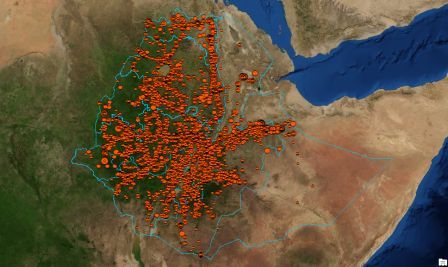
2013-04-23-Ethiopiamap-ARCMapSoftwareShowingFrequencyofSalesContactin2012cropped.jpg
This map, made with GIS, shows the frequency of DKT Ethiopia sales contacts in 2012.


NOTE: This originally appeared in the Huffington Post on April 24, 2013.
 
ADDIS Ababa, Ethiopia -- In just six years, DKT Ethiopia has transformed its system for tracking contraceptive sales from pins and pencils to computers and satellites and, in the process, helped create a family planning and HIV prevention success story in the Horn of Africa.

DKT Ethiopia is an affiliate of DKT International, a non-profit organization that seeks to provide couples with affordable and safe options for family planning and HIV prevention in 19 low- and middle-income countries. In Ethiopia, DKT uses social marketing to distribute three brands of condoms (and eight variants), three oral contraceptive pills, two IUDS, two injectables, one brand of emergency contraception and several other health products.

It was in 2007 that DKT Ethiopia started using GIS (Geographic Information System), a tool to display and analyze sales, finance and inventory information geographically and, particularly, to plot every one of its 30,000+ direct and indirect sales outlets. This has made an enormous difference in DKT's ability to know how its contraceptive sales are going in every corner of Ethiopia.

Before 2007, DKT used pins, pencils and Excel spread sheets to track this information, making it difficult and sometimes impossible to produce the desired information.

Monday, January 2, 2012

Top Ten Global Development Communications Stories of 2011

The first ladies of Kenya and South Africa tweeting for the first time at the Social Good Summit in New York.
This was originally posted to the Impatient Optimists, the blog of the Bill & Melinda Gates Foundation, on Dec. 21, 2011.
 
As was the case in 2010, global development non-profits continued their love affair with social media, finding Twitter, Facebook and the like amazing tools for communicating and advocating on a wide range of global issues. From global health to climate change to political systems, we’ve seen health improved, lives saved, policies changed, and governments overturned when we harness these new information pathways effectively.

Based on the 11,196 non-profit professionals surveyed in the 3rd Annual Non-Profit Social Network Benchmark Report,  the Facebook average member community size increased 161 percent in 2011, and the average Twitter base was up 2 percent. International groups reported the highest use of Facebook up by a whopping 97 percent, and nearly double the number of Twitter followers as compared to all non-profits. As a global health and development communicator, I’ve been tracking the incredible progression of how health and development organizations use both new and traditional media to connect, engage, and inspire.

It’s why I’ve created my very own Top 10 list of favorite global development communication picks of 2011. Now, on to my other subjective picks for 2011 (and, yes, the Gates Foundation is on the list!) in no particular order:

Monday, August 1, 2011

Farewell to Deauville: How did global health fare?

DEAUVILLE, France — Nothing of significance for global health came out of the G8 Summit here. We expected little, and the G8 lived up to our expectations.

President Sarkozy briefs the media at the Deauville Summit.
(Photo by David J. Olson)
Overall, the NGO community found the Deauville Declaration, in the words of Sherpa Times,  “vague, confused and lacking any sort of concrete advances on the main issues.” Most NGOs had criticized the Deauville Accountability Report, on global health and food security, as lacking in clarity and honesty.


The Global Health Council, in our official reaction to the Deauville Declaration, was kinder than most. We said the GHC “welcomes the G8 leaders’ reaffirmation of their commitment to global health as expressed in their Deauville G8 Declaration and urges them to live up to the promises of the declaration and to track their implementation in a fully transparent manner.” Frankly, we were vastly relieved that the declaration did address global health, and reaffirmed previous commitments, specifically, the Muskoka Initiative, the Global Fund to Fight AIDS, TB and Malaria, and the GAVI Alliance.

Wednesday, October 20, 2010

Women heroes of conservation are also improving health

WASHINGTON, D.C. - Earlier this month, I stepped out out of my comfort zone and went to an event on Capitol Hill that had nothing to do with global health, at least not directly. The event, “Women Heroes of Global Conservation,” honored six women who had done extraordinary things to save the planet.

Truth be told, I went to see Wangari Maathai, the 2004 Nobel Peace Prize winner for her work transforming women’s lives and the environment of her country Kenya through the Green Belt Movement she founded in 1977 and which has spread to 15 countries in Africa. Ms. Maathai was ill and could not be present but I heard from five other equally amazing women.

The overall event reinforced my perception that conservation and the environment has a lot to do with health. More and more, I see the links between health, climate change and the environment. We heard from these “Women Heroes of Global Conservation”:

* Mary Mavanza, Tanzania, manager of the TACARE program of the Jane Goodall Institute, has helped hundreds of Tanzanian women start environmentally sustainable business through microcredit loans and training. By improving economic conditions among women in and around Gombe National Park, the TACARE program has protected nearly 200,000 acres of forests and worked with 22 villages to create land use plans.

* Suzan Baptiste, Trinidad, founded Nature Seekers in 1990 and stopped turtle poaching. NatureSeekers is the largest employer in her region of Trinidad and has reforested large areas by hiring women to rehabilitate areas that were destroyed by fires or logging companies. She was named a CNN Hero in 2009.

* Sangduen “Lek” Chailert, Thailand, challenged and transformed traditional wildlife management techniques by setting up elephant sanctuaries and ecotourism program in northern Thailand, a country where there were once 300,000 elephants and now are not more than 3,000. Ms. Chailert has expanded this work to other areas of Thailand.

* Habiba Sarabi, Afghanistan, is the governor of Bamyan Province, the country’s first and only female governor. To improve the lot of women and communities, Governor Sarabi has increased tourism through conservation by creating Afghanistan’s first national Park, Band-e-Amir, protecting 220 square miles of pristine lakes and limestone canyons.

* Lucy Aquino, Paraguay: I was especially keen to hear from Ms. Aquino, who comes from Paraguay, a country where I lived four years and which has a special place in my heart. As the Paraguay director of the World Wildlife Fund, she has improved conservation and empowered women and communities for nearly 30 years. Paraguay once had had one of the highest rates of deforestation in the world in the Atlantic Forest Region, a highly threatened region where indigenous communities have been displaced with the men often going to work on cattle ranches or soybean farms, while their wives and children go to the cities to engage in begging, or worse. Ms. Aquino helped establish a Zero Deforestation Law, which resulted in a reduction in deforestation rates by 85%.

Several speakers, including Ms. Maathai, lamented the fact that the U.S. does not have a conservation strategy. “The U.S. has a thoughtful strategy for improving the well-being of women and girls around the world,” wrote Ms. Maathai in her statement. “It also has a global food security strategy, a global health strategy and a global climate change strategy. It will soon have a global development strategy. But because natural resources underpin each of these goals, there must also be a conservation strategy. None of these other strategies can truly succeed over the long term with one.”

To that end, Democrats and Republicans in the Senate and the House have come together to propose the Global Conservation Act of 2010 to prevent the destruction of our world’s forests, reefs and other ecosystems. On June 17, 2010, Senators Tom Udall, a liberal Democrat, and Sam Brownback, a conservative Republican, introduced legislation that would coordinate the work of all U.S. agencies involved in international conservation and establish a national strategy for promoting conservation.

According to the Alliance for Global Conservation, the main organizer of this event, health is one of the major benefits of conservation. Half of the new drugs created in the past 25 years have an ingredient derived from nature, according to the Alliance, and over 70% of all cancer drugs are based on natural compounds.

As the most senior representative of the U.S. government at the event, Undersecretary of State for Democracy and Global Affairs Maria Otero recounted a personal manifestation of climate change: The mountain she used to ski on when she was a child in her native Bolivia is now brown and barren of snow, she said.

Undersecretary Otero said that the U.S. is committed to international conservation, spending $300 million on it every year, and mentioned one recent example — the announcement of a Global Alliance for Clean Cookstoves, a public-private partnership led by the United Nations Foundation and several U.S. government agencies, to save lives, improve livelihoods, empower women and combat climate change by creating a market for clean and efficient cookstoves. Exposure to smoke from traditional stoves and open fires accounts for nearly 2 million premature deaths annually, with women and young children the most affected, according to the World Health Organization. This is one of the many ways conservation can improve human health.

So if you support global conservation, you are also supporting global health.

Saturday, May 22, 2010

World Health Assembly has its frustrations, but we have to try

GENEVA, Switzerland — My first World Health Assembly closed yesterday and I am trying to assess what difference it made, how the Global Health Council fits in and whether it is worth our time. I don’t even think I knew what WHA was when I was at PSI. I had heard of it — barely — but had no real idea what it did or why PSI should care.

I have since found out that the WHA is the mechanism through which the World Health Organization (WHO) is governed by its 193 member states, and is the world's highest health policy-setting body. The main tasks of the WHA are to approve the WHO program and budget for the next two years, and to decide major health policy issues.

I came away skeptical of our odds of influencing very much the global health dialogue that takes place in Geneva every may. But I also came away convinced that we — as leaders of civil society on global health issues — have to make every effort on behalf of our members who care about these issues, and very few of whom can come to Geneva themselves. That is one of the many things that they pay us to do when they sign on as members.

And just as I now feel that it is difficult for GHC — or any other member of civil society — to influence the G8 or G20, it is a very appropriate role for us to play as convener and representative of civil society on global health.

I was appalled at how civil society was marginalized (or even ignored) in the larger plenary meetings, where we were confined to an area that was way too small and where we could not hear anything if we did not have headphones, most of which did not work anyway.

But I was delighted that in other “special meetings” and “side events,” we could be sitting next to the health minister of Cambodia or Tanzania, and have just as good a chance of them as being called upon by the moderator to ask a question.

And, in the end, the Global Health Council got three minutes to address all 193 country members of the WHO: http://tinyurl.com/28m5kye. Where else would be get that opportunity?

Friday, September 25, 2009

G20 proves frustrating but Pittsburghers a delight

PITTSBURGH -- I just spent two days at the G20 Summit here trying to keep global health on the leaders' agenda, as it had been in Washington in November 2008 when they pledged to work on achieving the Millennium Development Goals. But it was completely absent from their agenda in Pittsburgh. This was a disappointment, but the incredible graciousness of Pittsburghers helped make up for it. A few examples:

The night before the opening of the summit, I was having a drink with a friend at a bar across the street from Pirates Stadium where the Pirates were playing the Reds. I would have like to have gone but we were headed for a party in a couple of hours. Imagine my delight when a man came by and dropped two free tickets on us. Five minutes later we were inside the stadium with a very sparse crowd (people were not coming downtown because of the G20) on a beautiful September evening sitting in very good seats!

We had to leave early to attend a party hosted by Teresa Heinz Kerry to raise support for the fight against global warming at the Andy Warhol Museum which, by the way is fantastic. There was great New Orleans music - Cajun, rock and jazz -- and great food and drink. Not to mention the art of Andy Warhol. When we were leaving about midnight, we could not find a taxi and when we called were told that one could not come in less than 45 minutes. A lovely couple overheard us and offered us a ride to our hotel -- even though it was in the opposite direction from their house!

And on the last day of the summit, two Save the Children colleagues and I were walking to the media center through downtown Pittsburgh with a very high level of security. Even though it was Friday, very few places were open. But when we spotted a coffee shop with the catchy name of "Crazy Mocha" we had to stop. When we walked into the shop, the two employees cheered and applauded us. They were so bored from the lack of customers, that they had to express their joy at seeing us!

Pittsburgh is a far more interesting city than I every imagined populated by warm, wonderful and quirky people and I would go back anytime. A very underated and very American city! I highly recommend it.

Friday, July 10, 2009

My Final Thoughts from L'Aquila

L'AQUILA, Italy -- I found out only eight days ago that I was coming to Italy to promote global health. I know global health and I know communications but I know little about the G8, and even less about how to budge this immense geo-politico-media mountain. But I came up with a plan and started learning quickly as soon as I hit Italian soil. Let me give you my plan, how I think I did and what I learned.

My communications plan was three-pronged: 1) Social media (mostly blogging), 2) major media relations and 3) U.S. government engagement.

1) The social media prong went brilliantly with lots of great support from colleagues in DC and Vermont. Earlier this week, I posted daily blogs. Once the summit began, I started posting multiple blogs per day. As I learned more and saw more, I had more and more ideas for blogs. Today, the last day, I have more ideas than I have time to write. I’ve been advised by the Council’s office in Washington that 700 people looked at my blog on Wednesday and I’ve received a dozen appreciative comments, some with questions, others with ideas. GHC/Vermont also had the idea of putting a link to the blog on our Facebook page, and we’ve received several comments there as well. We’ve also tweeted the G8, both from Italy and the U.S. and we’ve been “retweeted” by several GHC members like White Ribbon Alliance, PATH , Intrahealth, Women Deliver and others. Links to this blog have been placed on a number of other websites covering the G8 like this one put together by the Global Call for Action Against Poverty: link text

2) Major media engagement has been less successful even though all of us who work for non-governmental organizations are working out of the same media centres as the 3,500-some journalists covering this Summit. I heard from the diplomatic correspondent of the BBC the first day who wanted to talk to me about “backsliding” on the Millennium Development Goals. But I haven’t been able to get in touch with him since that first contact. I’ve also been trying to run down the phantom from the Financial Times (the friend of a friend) who staked out a computer in the media centre early on (marked “Financial Times”) but then never showed. Or at least I never saw him. Oddly, my single media success was when New York Times Columnist Nicholas Kristof, who was not at the Summit, wrote a column on the G8 using information supplied by me: link text

3) I failed totally to interact with the Administration except for the climate change briefing I attended by President Obama and five other G8 leaders yesterday which I don’t count because it had nothing to do with health (and, oh yeah, I didn’t actually talk to the President). There was absolutely no contact between the U.S. NGO delegation and the Administration of any kind during the Summit. In fact, we couldn’t get a meeting with them in Washington before the Summit either. The British NGOs met with their government. One member of our U.S. delegation even met with the head of the Japanese delegation. But none of us had any contact with our own government. This was surprising and disappointing.

The other thing that was surprising and disappointing is that neither global health nor water and sanitation came out very clearly in the comments of President Obama and his Administration or in the mainstream media except for two notable exceptions — the Kristof column already mentioned and French First Lady Carla Bruni-Sarkozy, who wrote a commentary in the Guardian of the U.K. Tuesday called “My Message to the G8 Leaders in L’Aquila,” one of them being her husband. As a global ambassador for the prevention of HIV in women and children, she wrote: ”Knowing that millions remain in need while effective interventions exist, I am more determined than ever to add my voice to the global effort to fight Aids and other infectious diseases.As the G8 meets in L’Aquila, leaders should feel proud of the revolution in global health they started eight years ago. I hope they will celebrate their achievements by expanding their investment in saving lives and reducing inequities. It is not only possible – it is happening, it works, and there is much more still to do.” Here is the commentary and check out the first comment following it: link text

As far as I know, that was the most prominent voice at the G8 advocating for global health, and I am grateful to Ms. Bruni-Sarkozy for that.

President Obama left L’Aquila about an hour ago, took a helicopter direct to Vatican City and has now been received with much pomp and pageantry by Pope Benedict II as we can see on the monitors in the media centre. Later tonight, Air Force One will touch down in Ghana, his first visit to sub-Saharan Africa as president. We have heard that the President and First Lady will be visiting a USAID-funded maternal health project at an Accra hospital, and we will be watching carefully in hopes that that visit takes place so that the U.S. First Lady joins with her fellow first ladies Carla Bruni-Sarkozy and Sarah Brown as a global health advocate.