Showing posts with label AIDS. Show all posts

Monday, March 18, 2019

In Brazil, condoms become popular by emphasizing fun, not responsibility

DKT promoted its Prudence brand of condoms in the São Paulo Carnival of 2019, as they do every year.

This was originally published by Knowedge4Health Blog on March 11, 2019.

SÃO PAULO, Brazil — In 1991, a non-profit social marketing organization set out to make condoms accessible and affordable in Brazil at a time when condoms were hard to find and expensive and the number of Brazilians infected with HIV was climbing. In the process, DKT Brazil made its brand Prudence the number one condom in the very competitive Brazilian market, and also helped enhance contraceptive security. 

The result is that condoms have become normalized in Brazil – more used and less stigmatized – and that has helped limit the spread of HIV.

In 1990, the World Bank estimated that Brazil would have 1.2 million people living with HIV by 2000. However, that never happened: By 2000, there were fewer than 500,000 infections. After peaking in 1996, according to UNAIDS, AIDS-related deaths have remained fairly stable. Brazil is now considered an HIV success story. Condoms – distributed both by the public and private sectors – played an important role in that success.

Prudencehas become the most popular condom in Brazil by taking a very different approach to the positioning and marketing. While most commercial condom distributors marketed their products for responsibility and protection, DKT eroticized its condom messaging, celebrated sexuality and used humorous vernacular, with no medical jargon. Its advertising was daring and provocative: The PrudenceYouTube page demonstrates that.

Friday, March 30, 2018

10 lessons we've learned from AIDS that we can apply to chronic diseases


An assistant at the Etoug-Ebe Baptist Hospital, a subsidiary of the Cameroon Baptist Convention Health Services, takes a blood sample of a patient participating in the Novartis Access program to fight non-communicable disease. Photo: Anne Mireille Nzouanekeu

This was originally published on the Huffington Post on October 30, 2017.

Communicable diseases like HIV/AIDS and malaria have taken a terrible toll on Kenya and other African countries over the last 20 years. In 2010, an estimated 51,000 Kenyans died from AIDS but that number has declined steadily, to 36,000 in 2016. Kenya is now considered an HIV success story. The same is true in many other countries.

Now there is a new epidemic of non-communicable diseases (NCDs) that is rising just as the world is starting to get a handle on communicable diseases, according to the Institute for Health Metrics and Evaluation. The Institute reports that the largest contributors to the loss of healthy life are now high blood pressure, smoking, high blood sugar and excess body weight.

But Dr. Samuel Mwenda, who knows a thing or two about both epidemics, believes there are lessons we have learned in the fight against communicable diseases that can now be applied to NCDs. Mwenda is general secretary and CEO of the Christian Health Association of Kenya (CHAK), a network of Protestant health facilities in Kenya. CHAK now supports 46,000 people living with HIV with antiretroviral therapy, representing about 9 percent of the total number of patients nationally.

In 2015, CHAK turned its attention to NCDs: With the support of Novartis Access, it began offering a portfolio of 15 products to treat cardiovascular disease, diabetes, respiratory illness and breast cancer at a price to governments, NGOs and other institutional customers not to exceed $1.00 per treatment per month. Since then, Novartis Access has also started working in Cameroon, Ethiopia, Pakistan, Rwanda and Uganda.

Wednesday, March 28, 2018

Initiatives to expand access to medicine on the rise, but need better evaluation

In Nairobi, Kenya, parents receive prescription medicines for their children as part of a free medical camp operated by Slums Information Development & Resources Centers. Photo: George Onyango, Courtesy of Photoshare

This was originally published on Global Health TV on August 31, 2018.

In the 1990s and 2000s, AIDS activists and other global health advocates started pressuring pharmaceutical companies to share their largesse with low- and middle-income countries (LMICs) by supplying critical medicines for free or at subsidized prices, especially for HIV/AIDS. The pressure was successful, and led to a series of access-to-medicine (AtM) initiatives.

The international community increasingly recognizes that the pharmaceutical industry must play a leading role in improving access to medicines. And apparently pharma companies themselves also acknowledge this responsibility, according to a study published in Health Affairs by a team of researchers at Boston University Department of Global Health. That study found that the number of these initiatives grew from 17 in 2000 to 102 in 2015. The researchers called this “clear evidence” that pharmaceutical companies had responded to calls to increase their commitment to improving access to medicines.

Thursday, March 22, 2018

Budget debates in US, UK could augur poorly for global health funding

This was originally published in Global Health TV on July 25, 2017.

Global health financing has not been in such jeopardy since the large investments in it started in 1991 – the year in which global health funding started an upward trajectory that moved higher in all but three years.
In particular, the rise of Donald Trump of the United States and Theresa May of the United Kingdom the leaders of the two largest donor nations  have raised concerns about the prospects for development assistance broadly, and global health specifically.
In 2016, development assistance for health (DAH) reached $37.6 billion, eking out a miniscule 0.1% increase from 2015 that followed a pattern of little growth since 2010 (DAH grew 11.4% annually from 2000 to 2010 but only 1.8% since 2010), according to “Financing Global Health 2016,” published by the Institute for Health Metrics and Evaluation in April. DAH peaked at $38 billion in 2013, dropped to $36 billion in 2014 and has recovered slightly in the two subsequent years. This infographic provides a snapshot.
The U.S. and the U.K. have been the two top contributors to DAH but both countries have political environments that have called into question their future commitments to foreign aid and global health.

Thursday, May 4, 2017

Though preventable, cervical cancer causes half million cases per year

Four volunteers of ICANSERVE Foundation exhort women to take advantage of free cervical and breast cancer screening at an event in the Philippines. Photo: ICANSERVE Foundation

This was originally published on Global Health TV on February 28, 2017.

Over 16 years ago, Sally Kwenda survived colon cancer and HIV, and then lost her husband and two children to AIDS-related illnesses.

Sally Kwenda
“Just when I thought I was done with the hurt and the pain, I was diagnosed with stage II cervical cancer,” she recalls. “Many of those I have met on this journey have either passed away or are worse off than me. Many of them got their diagnoses when it was too late to change the tide. Yet cancer does not have to be a death sentence. My experience reveals that cancer is curable.”

Cervical cancer is the most common cancer among women in Sally’s home country of Kenya as well as in 38 low- and middle-income countries, mainly in sub-Saharan Africa, according to the American Cancer Society (ACS).

The reasons for the high rates of cervical cancer in Kenya, according to Deborah Olwal-Modi, executive director of the Kenya Cancer Association, include lack of knowledge and awareness, inadequate facilities for prevention and treatment, economic barriers, and co-morbidity of cervical cancer and HIV/AIDS. For example, almost all women (97 percent) do not know that a virus causes cervical cancer, according to a new study among women in major Kenyan cities.

Wednesday, April 5, 2017

New test to detect HIV in babies boosts hope of meeting UN targets

This was originally published on Global Health TV on October 25, 2016.

When Saquina, a 38-year-old single mother living in Nacala Porto, Mozambique, learned she was HIV positive while pregnant, she thought her life was over. Instead, she decided to accept her HIV status and follow the advice of the nurse who counseled her.
She did not miss any visits to the health center. She took the pills that helped prevent transmission of the virus to her unborn child. She participated in support groups with other HIV-positive mothers. When her son Frenchou was born, she gave him medication every day and breastfed him exclusively for six months.
When he was two years old, Frenchou was tested for HIV and found negative  another of many recent successes in the prevention of mother-to-child transmission (PMTCT), according to the Elizabeth Glaser Pediatric AIDS Foundation.
Between 2009 and 2015, there was a 60% decline in new HIV infections in children in the 21 priority countries, according to a UNAIDS report released in June. Seven of those countries reduced infections by more than 70%. A total of 1.2 million new infections among children were averted in these countries.
But if you thought thought that all is now well with PMTCT, and that we can move on to other HIV challenges, you would be mistaken. While a 60% drop is certainly encouraging, it is significantly below the 90% target set by the World Health Organization (WHO). UNAIDS has set a goal of eliminating all new HIV infections among children by 2020 while ensuring that 1.6 million children have access to HIV treatment by 2018.

Thursday, September 1, 2016

Kenya starts to shift focus to chronic diseases while not relenting in HIV fight

A patient at a rural health camp in Mwae County, Kenya has his blood pressure checked as part of a full physical exam. If he needs hypertension treatment, he will get it as part of the cost of the camp. Photo: Bedad Mwangi

This was originally published on Global Health TV on June 28, 2016.

For some time, huge disparities between global health spending and the global disease burden have raised concerns that this funding was not being allocated based on the evidence. That is, money was not always going where the disease burden was greatest.

The Institute for Health Metrics and Evaluation (IHME) has pointed out that the disparities are most extreme in HIV/AIDS on the high end and non-communicable diseases (NCDs) on the low end.

As the toll from communicable diseases like AIDS and malaria decline and people live long enough to get NCDs, we need to invest more in fighting NCDs (also called “chronic diseases”) and reduce these glaring disparities between global health spending and disease burden. Countries like Botswana, Eritrea, Kenya Malawi, Mozambique, Rwanda, South Africa, Swaziland, Tanzania, Uganda, Zambia and Zambia — all countries that increased their treatment coverage by more than 25% between 2010 and 2015, according to UNAIDS — now have to pivot to NCDs without taking their eyes off of HIV.

Kenya is an excellent case in point.

Monday, August 29, 2016

A Christian warrior for health takes on chronic disease after battling AIDS

Dr. Samuel Mwenda after receiving the award as the 2016 Christian International Health Champion.

This was originally published on the Huffington Post on June 21, 2016.

In Kenya, non-communicable diseases (NCDs) such as cardiovascular and respiratory disease, diabetes and cancer used to be quite rare, because communicable diseases like AIDS and malaria were more likely to kill you first. That is why life expectancy peaked in 1987, and then went down in the 1990s, as AIDS made its presence felt.

But since about 2002, as more Kenyans have gotten AIDS treatment, life expectancy has started going up again and, if current trends continue, Kenya will return to its historic peak of 60 years in 2017, according to a World Bank blog.

That’s great news. But it also means many Kenyans are surviving AIDS only to live long enough to be killed by NCDs. Annually, 28 million people die from NCDs in low- and middle-income countries like Kenya, representing nearly 75% of deaths from NCDs globally. Health programs, therefore, must turn their attention to this new pandemic without losing focus on the existing one (AIDS). This scenario is playing out not only in Kenya but also in Botswana, Eritrea, Malawi, Mozambique, Rwanda, South Africa, Swaziland, Tanzania, Uganda, Zambia and Zambia. All of these countries increased their treatment coverage by more than 25% between 2010 and 2015, according to UNAIDS.

Dr. Samuel Mwenda is a seasoned veteran of campaigns against both pandemics. For 13 years, as the general secretary and CEO of the Christian Health Association of Kenya, a network of Protestant church facilities in Kenya, he has led CHAK’s comprehensive approach to HIV/AIDS prevention, care and treatment. Kenya is now considered an AIDS success story, with CHAK making a significant contribution to that success. UNAIDS says that Kenya is one of the countries “showing the most remarkable progress in expanding access to antiretroviral medicines and reducing the number of new infections.”

Thursday, May 12, 2016

In West Africa, progress on family planning but millions not treated for HIV

Women gather for the launch of the national family planning campaign in a low-income neighborhood of Bamako, Mali in April.
This was originally published on Global Health TV on April 26, 2016.

BAMAKO, Mali — Last year, there were several reports of how West Africa, after decades of seriously lagging behind the rest of the world (and Africa) in family planning, was finally starting to embrace it. IntraHealth International covered this topic extensively on its Vital blog, and I wrote about my own views of family planning in Mali here at Global Health TV.

Senegal, in particular, emerged as a family planning leader in West Africa and provided hope for the rest of the region. The three main reasons for Senegal’s success were strong political will, better coordination and collaboration and innovative approaches, according to Babacar Gueye, IntraHealth country director in Senegal.

New programs here in Mali, like Keneya Jemu Kan (USAID Communications et Promotion de la Santé, in the Bambara language), are making a major push to increase health indicators beyond the anemic progress of the past three decades. For example, the percentage of married women using any modern method of family planning in Mali has only increased from 1.3% in 1987 to 9.9% in 2013, and Keneya Jemu Kan is working to bend that rate upwards. (Full disclosure: I work as a consultant for Keneya Jemu Kan).

But a disturbing new report from Médecins Sans Frontières (MSF), or Doctors Without Borders, claims that similar progress is not being made in HIV/AIDS. On the contrary, MSF claims that millions of people in West and Central Africa are being left out of the global HIV response despite globally agreed goals to curb HIV by 2020, and is calling on the international community to develop and implement an urgent plan to scale up antiretroviral treatment for countries where critical medicines reach fewer than one-third of the population in need.

Tuesday, December 29, 2015

The biggest global health stories of 2015, and one untold story

A billboard warning about Ebola in Bamako, Mali.
This was originally published on Global Health TV on December 17, 2015

There seemed to be a lot of good global health news in 2015, especially when compared to 2014, when Ebola was ravaging West Africa and scaring the rest of the world. In the last 12 months, Ebola has mostly passed, progress was made against malaria and AIDS and the climate deal in Paris raised hopes that less climate change could improve global health.  Here are what I consider some of the top global health stories of the year, not necessarily in order of priority:

Ebola on the Decline: A year ago, Ebola was raging. As of Dec. 16, there have been 11,315 deaths and 28,640 cases of Ebola. But Ebola has not disappeared entirely. It re-emerged in Liberia after having earlier been declared Ebola-free. Dr. David Nabarro, the UN special envoy on Ebola, said that he expects transmission in Guinea to finish before the end of 2015 and in Liberia in early 2016. Here’s an update on Ebola in an interview with Dr. Nabarro.

Friday, August 28, 2015

Global health funding: Huge increases since 2000, but also huge disparities

This was originally published on Global Health TV on July 27, 2015.

As the end of the era of the Millennium Development Goals (MDGs) (2000-2015) draws near, we who work in global health can look back with some satisfaction at the $228 billion that was allocated to address the three health-related MDGs during that time.

Although spending grew rapidly in the first ten years, it was stagnant between 2010 and 2014, and actually decreased by 1.6% between 2013 and 2014. Global health funding in 2014 amounted to $36 billion in 2014 (of which $1 billion was for Ebola).

That information comes from Financing Global Health 2014: Shifts in Funding as the MDG Era Closes, the annual report of global health funding published last month by the Institute for Health Metrics and Evaluation (IHME).

And two weeks ago, the Kaiser Family Foundation and UNAIDS issued a report that showed that although there was only a slight increase in funding for HIV in low- and middle-income countries in 2014 (less than 2%), seven of 14 donor countries actually decreased funding despite the recent gains made against the epidemic.

Monday, January 5, 2015

The top 10 global health stories of 2014

This was originally published by Global Health TV on Dec. 22, 2014.

Ebola, the biggest global health story of the year, is one that no one could have predicted when the year dawned almost 12 months ago. It did something that few global health stories do: It entered the consciousness of the global public in an important way. Beyond Ebola, though, there was much to celebrate in 2014.

Ebola: That one word represented not only the biggest global health story of the year, but one of the biggest stories of the year, of any type. As of Dec. 17, the World Health Organization (WHO) reported 18,603 cases and 6,915 deaths. Late in the year, incidence was declining in Liberia, slowing in Sierra Leone and “fluctuating” in Guinea. Sierra Leone surpassed Liberia as the country with the most reported cases. As I wrote here on Global Health TV last month, Ebola has made the definitive case for stronger health systems and health workers in developing countries.

Friday, January 2, 2015

Young people most affected by HIV finally gain a seat at the table

Link Up aims to improve the sexual and reproductive health and rights of more than one million young people living with and most affected by HIV in Bangladesh, Burundi, Ethiopia, Myanmar and Uganda. Here's a group of young people above in Ethiopia. Credit: International HIV/AIDS Alliance
This blog was originally published by the Huffington Post on Dec. 1, 2014.

Earlier this year, young Ugandans saw an opportunity to influence the HIV response in their country by coming together to determine their priorities for the New Funding Model of the Global Fund to Fight AIDS, Tuberculosis and Malaria, a major funder of HIV programs.

The meeting included young members of “key populations,” including people living with HIV, people who use drug, sex workers, transgender persons, men who have sex with men, fisher folk and truckers, and was facilitated by young women living with HIV. These young people are rarely consulted in a meaningful way in the design and implementation of HIV/AIDS programs, even programs targeting them, in Uganda and globally.

These priorities were eventually shared in the form of a Young Key Populations Priorities Charter. The priorities identified provided a template for action that, if accepted by the Global Fund, could lead to more effective programming for young people, increased engagement by young people in policy development and national planning processes and, ultimately, genuine change on the ground.

This is one example of how young people, and particularly those living with HIV and from these key populations, are starting to engage meaningfully in the design and implementation of HIV/AIDS programs meant to help them, something long past due.

Tuesday, November 11, 2014

Justified focus on Ebola should not compromise efforts against other diseases that kill more people

This blog originally appeared on Global Health TV on Sept. 23, 2014.

Ebola is a terrible disease that has already infected 5,335 people and killed 2,630 as of Sept. 14, according to the World Health Organization (WHO), and threatens to kill many more thousands before its rampage of destruction is slowed down or stopped. WHO designated it as a global emergency on Aug. 8.

“This Ebola epidemic is the largest and most severe and most complex we have ever seen in the nearly 40-year history of this disease,” said Margaret Chan, director-general of the WHO. “This is a global threat that requires global coordination to get it done. We can and we will bring the Ebola epidemic under control.”

Yet another of its terrible legacies may be that it will distract attention and resources from other diseases that are killing far more people.

Thursday, August 28, 2014

We will not banish AIDS until we banish stigma

Eugene comes to a drop-in center for men who have sex with men.

This originally appeared on the ONE Campaign Blog on July 23, 2014.

Earlier this year, I met Eugene and Dominique at a drop-in center for men who have sex with men (MSM) outside Nairobi, Kenya.

Eugene, 23, comes to the center regularly to get condoms, lubricants and HIV counseling and testing, and has brought other gay men to the center. So far, he is HIV-negative.

Dominique, 26, also frequents the center. He was treated for a sexually-transmitted infection, and gets tested there every month. He, too, is HIV-negative.

In Kenya, most gay men are very much in the closet, due to the strong stigma against them. Many of these men would not have access to health services if not for the handful of drop-in centers in Nairobi, Kisumu and other urban centers for the simple reasons that most health facilities are not gay-friendly. Quite the contrary. Thus, most MSM have no access to gay-friendly services.

Sunday, June 29, 2014

Kenya quietly takes public health approach with HIV most at-risk groups

Chief Rose Ayere talks to a group of injecting drug users in Nairobi.
This was originally published on Global Health TV on May 27, 2014.

NAIROBI and KISUMU, Kenya — Anti-gay legislation recently signed into law in Uganda and Nigeria has alarmed organizations implementing HIV prevention in Africa, fearing that such laws will further stigmatize and marginalize at-risk populations already hard to reach with health services.

So when I traveled to Kenya this month to interview men who have sex with men (MSM), injecting drug users (IDUs), and people working in programs trying to help them supported by the International HIV/AIDS Alliance, I wondered whether I would encounter “the next Uganda” in gay rights. I did not, but what I did find surprised me.

Thursday, May 8, 2014

Movers, shakers, thinkers, doers converge on former N.C. mill town

This was originally published by the Huffington Post on April 9, 2014.

One is a British mobile phone guru who has become a storyteller of "reluctant innovators," propelling some of the most exciting social innovations outside the traditional development system.

Another is an architectural wunderkind from Togo in West Africa who leads a team that recycles old plastic bags into building materials.

And a third is a San Francisco Bay Area global health tech innovator who is building a web platform to help African countries make better decisions about HIV drug procurements. He speaks English, Punjabi, Spanish and Mongolian.

The three are very different but have at least two things in common: First, they are hellbent on changing the world. Second, they are converging on the tiny former mill town of Saxapahaw, North Carolina later this month to share their distinctive world views with hundreds of other global thinkers and doers.

Tuesday, January 7, 2014

Ethiopia: An emerging family planning success story

Delegates at the International Conference on Family Planning pose for a photo in front of DKT Ethiopia's coffee ceremony tent.

This was co-written with Andrew Piller and originally published on Impatient Optimists on Dec. 10, 2013.
When global family planning practitioners gathered in November for the Third International Conference on Family Planning, there was a timely relevance for meeting in Ethiopia. Over the last two decades, Ethiopia has become a family planning success story, one of only a handful of countries in Africa to achieve that status.
 Positioning of population and family planning at the center of development is critical.In 2000, Ethiopia’s contraceptive prevalence rate for modern methods was only 6.3 percent, which, at that time, was lower than any other country in Eastern and Southern Africa except Eritrea. By 2011, the rate had increased to 27.3 percent. Over the same period, the total fertility rate (the average number of children born to a woman in her lifetime) had decreased from 5.5 to 4.8.

Friday, April 26, 2013

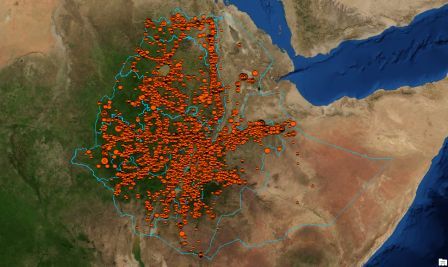
Geographic technology helps put Ethiopia on map of global health success

2013-04-23-Ethiopiamap-ARCMapSoftwareShowingFrequencyofSalesContactin2012cropped.jpg
This map, made with GIS, shows the frequency of DKT Ethiopia sales contacts in 2012.


NOTE: This originally appeared in the Huffington Post on April 24, 2013.
 
ADDIS Ababa, Ethiopia -- In just six years, DKT Ethiopia has transformed its system for tracking contraceptive sales from pins and pencils to computers and satellites and, in the process, helped create a family planning and HIV prevention success story in the Horn of Africa.

DKT Ethiopia is an affiliate of DKT International, a non-profit organization that seeks to provide couples with affordable and safe options for family planning and HIV prevention in 19 low- and middle-income countries. In Ethiopia, DKT uses social marketing to distribute three brands of condoms (and eight variants), three oral contraceptive pills, two IUDS, two injectables, one brand of emergency contraception and several other health products.

It was in 2007 that DKT Ethiopia started using GIS (Geographic Information System), a tool to display and analyze sales, finance and inventory information geographically and, particularly, to plot every one of its 30,000+ direct and indirect sales outlets. This has made an enormous difference in DKT's ability to know how its contraceptive sales are going in every corner of Ethiopia.

Before 2007, DKT used pins, pencils and Excel spread sheets to track this information, making it difficult and sometimes impossible to produce the desired information.

Thursday, April 25, 2013

Quacks, traditional healers and village doctors: Informal providers emerge as force in health care

An advertisement for a traditional healer in Zambia.
This piece was originally published on the PSI Impact Blog on April 9, 2013.
 
In my nine years managing social marketing programs for PSI in Africa, Asia and Latin America, I had two significant encounters with the category of health workers now known as “informal providers,” in Zambia and Bangladesh. In both cases, my PSI staffs and I decided to try to work with them because it seemed like folly not to work with them, given their numbers and their influence.

In Zambia, where I founded and managed PSI’s social marketing program, I became aware of the large and prominent role of traditional healers in the health system. They were everywhere – including where there were few or no formal providers – and were a respected part of the health landscape. Eventually, I became convinced that we should engage them in our HIV prevention condom social marketing program.

Realizing that traditional healers, like most players in the private sector, are motivated by financial gain, we recruited them as condom vendors, just as we had recruited wholesalers and retailers like pharmacies and grocery stores. Traditional healers saw condoms as a business opportunity and started out as good sales agents. Unfortunately, they were not always trustworthy business people: They insisted on buying on credit, but would not settle their accounts after making sales, so we had to terminate our relationship with them. Nonetheless, it was my first lesson in the importance of trying to engage traditional healers and other types of “informal providers” outside the formal health system, challenging though they could be.

Earlier this year, I started learning more about informal providers from the Center for Health Market Innovations (CHMI) which has supported studies of informal providers and focused a lot of attention on their contributions to health systems around the world.