Showing posts with label mHealth. Show all posts

Saturday, May 7, 2016

Amid a flurry of high-tech approaches, some find merit in low-tech techniques

DKT street theater provides family planning information in Bihar.
This was originally published on Humanosphere blog on March 7, 2016.

Because of the meteoric rise of the internet and cell phones in many developing countries, many global health programs have been rushing to embrace these technologies as efficient ways of reaching large numbers of people with information on such issues as family planning, HIV prevention and maternal and child health.

This is happening in countries like India, Tanzania, South Africa, and Ethiopia, where technologies like the internet, mobile phones, social media and geographic positioning systems are bringing health delivery into the 21st century.

But some programs are eschewing high tech and sticking with low tech as the best way to bring vital health information to their low-income consumers, at least for now.

Wednesday, December 23, 2015

Killing 5 million a year, diabetes becomes major menace to global health

This was originally published on Global Health TV on November 23, 2015.

Over the last 25 years, diabetes has emerged as a major threat – and growing consumer of precious global health resources – in the developing world. In 1990, according to the Institute for Health Metrics and Evaluation (IHME), it was not even in the top ten leading causes of death globally.  Now it is number nine on the list.

In the seventh edition of its Diabetes Atlas, the International Diabetes Federation (IDF), an umbrella organization of over 240 national diabetes associations, says that diabetes kills almost 5 million people every year and that every six seconds a person dies from diabetes. This compares to those who die each year from AIDS (1.5 million), tuberculosis (1.5 million) and malaria (600,000).

The latest version of the Diabetes Atlas, which will be published on Dec. 1, calls diabetes “one of the largest global health emergencies of the 21st century.” Currently, 415 million people have it (1 in 11). By 2040, if current trends continue, 642 million will have it (1 in 10).

Friday, April 26, 2013

Geographic technology helps put Ethiopia on map of global health success

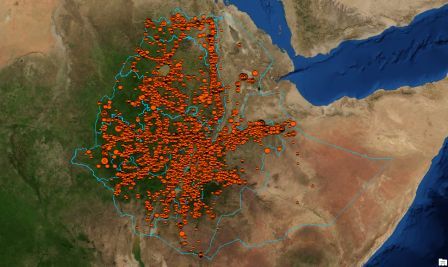
2013-04-23-Ethiopiamap-ARCMapSoftwareShowingFrequencyofSalesContactin2012cropped.jpg
This map, made with GIS, shows the frequency of DKT Ethiopia sales contacts in 2012.


NOTE: This originally appeared in the Huffington Post on April 24, 2013.
 
ADDIS Ababa, Ethiopia -- In just six years, DKT Ethiopia has transformed its system for tracking contraceptive sales from pins and pencils to computers and satellites and, in the process, helped create a family planning and HIV prevention success story in the Horn of Africa.

DKT Ethiopia is an affiliate of DKT International, a non-profit organization that seeks to provide couples with affordable and safe options for family planning and HIV prevention in 19 low- and middle-income countries. In Ethiopia, DKT uses social marketing to distribute three brands of condoms (and eight variants), three oral contraceptive pills, two IUDS, two injectables, one brand of emergency contraception and several other health products.

It was in 2007 that DKT Ethiopia started using GIS (Geographic Information System), a tool to display and analyze sales, finance and inventory information geographically and, particularly, to plot every one of its 30,000+ direct and indirect sales outlets. This has made an enormous difference in DKT's ability to know how its contraceptive sales are going in every corner of Ethiopia.

Before 2007, DKT used pins, pencils and Excel spread sheets to track this information, making it difficult and sometimes impossible to produce the desired information.

Monday, January 2, 2012

Top Ten Global Development Communications Stories of 2011

The first ladies of Kenya and South Africa tweeting for the first time at the Social Good Summit in New York.
This was originally posted to the Impatient Optimists, the blog of the Bill & Melinda Gates Foundation, on Dec. 21, 2011.
 
As was the case in 2010, global development non-profits continued their love affair with social media, finding Twitter, Facebook and the like amazing tools for communicating and advocating on a wide range of global issues. From global health to climate change to political systems, we’ve seen health improved, lives saved, policies changed, and governments overturned when we harness these new information pathways effectively.

Based on the 11,196 non-profit professionals surveyed in the 3rd Annual Non-Profit Social Network Benchmark Report,  the Facebook average member community size increased 161 percent in 2011, and the average Twitter base was up 2 percent. International groups reported the highest use of Facebook up by a whopping 97 percent, and nearly double the number of Twitter followers as compared to all non-profits. As a global health and development communicator, I’ve been tracking the incredible progression of how health and development organizations use both new and traditional media to connect, engage, and inspire.

It’s why I’ve created my very own Top 10 list of favorite global development communication picks of 2011. Now, on to my other subjective picks for 2011 (and, yes, the Gates Foundation is on the list!) in no particular order:

Tuesday, September 13, 2011

Social Good Summit aims to put social media to work for development during UN Week

African first ladies tweeting for the first time is only one of many wonders of technology and global development to be highlighted at the upcoming Social Good Summit and its Digital Media Lounge to be held during the U.N. General Assembly next week in New York.

The United Nations Foundation and its high tech partners behind the Summit gave us a sneak peek of coming attractions during a tele-briefing yesterday.

There will be a head of state at the Social Good Summit — President Kikwete will accept an award for his commitment to furthering technology and new media in Tanzania — and the first ladies of Kenya, Nigeria and South Africa will also be on hand to tackle Twitter. In an event entitled “First Ladies, First Tweets,” they will publicly demonstrate their first efforts to harness social media to advance their issues.