Thursday, January 2, 2014

Reaching most vulnerable young people with family planning, HIV services

More than half of Ethiopia's population are young people under the age of 24. Credit: Sheikh Rajibul Islam/duckrabbit

This article was originally published on The Huffington Post on Nov. 11, 2013.
Ethiopia -- where international advocates will open their biennial International Conference on Family Planning on Nov. 12 -- has succeeded in bringing down the unmet need for family planning from 36.6 percent of currently married women 15-49 in 2000 to 26.3 percent in 2011. But the unmet need is greatest among those aged 15 to 19. In that age range, almost one-third want contraception and cannot get it.
The great need of young people for integrated family planning, sexual and reproductive health (SRH) and HIV prevention services is not limited to Ethiopia, and is one of the great challenges facing conference participants. This is particularly true of youth from marginalized groups such as people living with HIV, sex workers, men who have sex with men, transgender people and people who inject drugs, who may be particularly vulnerable to sexually-transmitted infections, including HIV, and other reproductive health issues.

Saturday, October 12, 2013

Years of investments put health workers on global stage

Two midwives in a low-income area of Jakarta, Indonesia that are part
of DKT's "Andalan" social franchising network.

This article was originally published in The Huffington Post on Sept. 23, 2013.

For almost 10 years, I managed health programs in Africa, Asia, and South America that harnessed social marketing techniques to produce tangible benefits for poor consumers. Our programs made low-cost products such as condoms, contraceptives, and oral rehydration salts available at reduced, affordable prices. We worked mostly through the private sector and were proud of our bottom-line health impact. We didn't think much about underlying health systems or how to improve them. And if we had, we probably would have dismissed health system strengthening as overly ambitious.

But I've been thinking more about health systems lately, as I have seen governments and their nongovernmental partners carefully and patiently nurse ailing systems to health. The payoffs are not immediate -- far from it -- but as we move away from the segmented solutions to global health that prevailed in the 2000s (such as in the cases of AIDS and malaria) and toward greater country ownership, there is a growing consensus that we need stronger health systems to make sustainable improvements in global health.


This means more, better trained, and better managed frontline health workers -- the backbone of health systems.
I've heard that mantra for the last few years but, in 2012 and 2013, I saw it play out repeatedly as I traveled to very different countries in Africa, Asia, and Latin America:

Monday, September 9, 2013

Changing lives of poor Brazilian families, Saúde Criança wants to do the same globally

Saúde Criança offers job training, like this class for aspiring cooks.

NOTE: This originally appeared in the Huffington Post on Sept. 3, 2013.
 
RIO DE JANEIRO, Brazil -- Maria do Carmo has no husband, but has a daughter, Simone, "who is 37 but acts like she is three," she says, and is completely dependent on her. Simone was impregnated during a rape and gave birth to a son, Victor Hugo, now three, who is blind and mute, has cerebral palsy, gastroenteritis and almost died of pneumonia. This was Maria's life two years ago. The family had no government benefits even though both Maria's daughter and grandson are eligible. She wept as she told her story.

Then Saúde Crianca, a social entrepreneurial non-profit organization founded in Rio de Janeiro in 1991, came into her life. They helped her understand her rights as a citizen, and to obtain benefits for her grandson. She still needs help for her daughter but, unfortunately, the government only allows benefits for one person per family. Saúde Criança is prepared to give her job training, but Maria has no time for classes, because she has to take her grandson to the doctor everyday.

Maria is an extreme -- but not unusual -- example of the kinds of cases that Saúde Criança handles everyday in their offices in the green splendor of Parque Lage in the neighborhood of Jardim Botânico. It was created by Dr. Vera Cordeiro after several years of treating patients at Hospital da Lagoa, where she noticed that many sick children were admitted and cured only to return to the hospital later, almost always with the same disease. Dr. Cordeiro founded Saúde Criança to try to break this devastating cycle of disease-hospitalization-discharge-misery-disease.

Friday, April 26, 2013

Geographic technology helps put Ethiopia on map of global health success

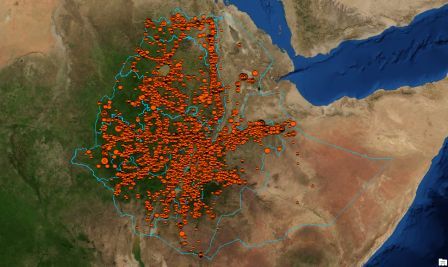
2013-04-23-Ethiopiamap-ARCMapSoftwareShowingFrequencyofSalesContactin2012cropped.jpg
This map, made with GIS, shows the frequency of DKT Ethiopia sales contacts in 2012.


NOTE: This originally appeared in the Huffington Post on April 24, 2013.
 
ADDIS Ababa, Ethiopia -- In just six years, DKT Ethiopia has transformed its system for tracking contraceptive sales from pins and pencils to computers and satellites and, in the process, helped create a family planning and HIV prevention success story in the Horn of Africa.

DKT Ethiopia is an affiliate of DKT International, a non-profit organization that seeks to provide couples with affordable and safe options for family planning and HIV prevention in 19 low- and middle-income countries. In Ethiopia, DKT uses social marketing to distribute three brands of condoms (and eight variants), three oral contraceptive pills, two IUDS, two injectables, one brand of emergency contraception and several other health products.

It was in 2007 that DKT Ethiopia started using GIS (Geographic Information System), a tool to display and analyze sales, finance and inventory information geographically and, particularly, to plot every one of its 30,000+ direct and indirect sales outlets. This has made an enormous difference in DKT's ability to know how its contraceptive sales are going in every corner of Ethiopia.

Before 2007, DKT used pins, pencils and Excel spread sheets to track this information, making it difficult and sometimes impossible to produce the desired information.

Thursday, April 25, 2013

Quacks, traditional healers and village doctors: Informal providers emerge as force in health care

An advertisement for a traditional healer in Zambia.
This piece was originally published on the PSI Impact Blog on April 9, 2013.
 
In my nine years managing social marketing programs for PSI in Africa, Asia and Latin America, I had two significant encounters with the category of health workers now known as “informal providers,” in Zambia and Bangladesh. In both cases, my PSI staffs and I decided to try to work with them because it seemed like folly not to work with them, given their numbers and their influence.

In Zambia, where I founded and managed PSI’s social marketing program, I became aware of the large and prominent role of traditional healers in the health system. They were everywhere – including where there were few or no formal providers – and were a respected part of the health landscape. Eventually, I became convinced that we should engage them in our HIV prevention condom social marketing program.

Realizing that traditional healers, like most players in the private sector, are motivated by financial gain, we recruited them as condom vendors, just as we had recruited wholesalers and retailers like pharmacies and grocery stores. Traditional healers saw condoms as a business opportunity and started out as good sales agents. Unfortunately, they were not always trustworthy business people: They insisted on buying on credit, but would not settle their accounts after making sales, so we had to terminate our relationship with them. Nonetheless, it was my first lesson in the importance of trying to engage traditional healers and other types of “informal providers” outside the formal health system, challenging though they could be.

Earlier this year, I started learning more about informal providers from the Center for Health Market Innovations (CHMI) which has supported studies of informal providers and focused a lot of attention on their contributions to health systems around the world.

Sunday, March 17, 2013

In South Africa, an HIV campaign with a personal touch struggles to show its relevance

A Banake field worker talks to a family in Khayelitsha. Photo by Nicole Safker.
NOTE: This was originally published on the Knowledge4Health Blog on March 5, 2013.

Residents of Khayelitsha worry about a neighbour’s daughter who is only 13 but does not go to school because she cannot afford transport. She was raped by an old man. Her mother does not care and drinks a lot, swears at her about the rape and hits her. The child wants to go to school, so she went to stay in a neighbour’s home. The neighbour is also struggling and cannot afford the transport and school fees.  Banake Initiative Field Worker Diary

This is only one of many heart-breaking stories from the notes of field workers involved in an effort to improve communication among families affected by HIV/AIDS and encourage them to use HIV prevention services in Khayelitsha, the largest township of Cape Town, South Africa. The notes reveal shocking callousness and indifference on the part of township residents, but also compassion, like the neighbor who gave shelter to the 13-year-old girl.

The Banake Initiative was started in 2009 by DKT South Africa, an affiliate of DKT International, whose normal approach is focused on getting affordable health products and services to low-income people through the private sector. However, DKT decided that a different approach was required in South Africa, where HIV prevalence of people 15-49 has been stuck at around 17% since 2003 (the fourth highest rate in the world) despite years of work by many well-financed programs and the excellent availability of condoms (In November 2012, UNAIDS announced that the rate of new infections in South Africa had been reduced by 41% between 2001 and 2011).

Monday, March 11, 2013

In Costa Rica, strengthening health systems has a human side

A lab technician at the blood bank of Hospital de los Niños in San Jose.
NOTE: This originally appeared on the Impatient Optimists blog on February 28, 2013.
 
SAN JOSÉ, Costa Rica — Until I came here, I thought of “health system strengthening” strictly in clinical, technical terms – as a set of procedures for improving HIV testing, disposal of bio-waste, and health data management.

It is indeed all of those things, as I learned during a visit to a program working to improve care for people living with HIV led by IntraHealth International , a non-profit organization that empowers health workers to serve better communities in need,  but it also has a more human side.

Over two days, I spoke with a dozen health workers and managers about IntraHealth’s Central America Capacity Project. Several of them referred to these technical improvements as the calidad (or quality) side of health system strengthening, but they seemed to place equal emphasis on calidez (warmth). Many of the calidez changes can be made without incurring much, if any, financial cost. Virtually all of the health workers I talked to gave me examples of calidad and calidez:
  • A lab technician at Hospital Dr. Max Peralta in Cartago, about 20 kilometers from downtown San José, emphasized improved procedures in handling of bio-wastes (calidad).
  • The head of the blood bank at the Hospital de los Niños (Children’s Hospital) said that one of Capacity’s most important changes was simply securing a room where blood bank staff could talk to blood donors in private (calidez).
  • Dr. Luis Ledesma, former director of Hospital de las Mujeres (Women’s Hospital), says Capacity has improved both types of health care, and he gave an example of each. Calidad: Improving and increasing HIV testing. Calidez: Calling a person by their name.