Wednesday, January 8, 2014

In Ethiopia, the beat goes on, in music and health

Global youth dance at the beat making session at the International Conference on Family Planning in Addis Ababa. Credit: Laura Hoemeke/IntraHealth

This was originally published in the Huffington Post on Dec. 11, 2013.
ADDIS ABABA, Ethiopia -- In November, in a chilly outdoor amphitheater at the African Union headquarters here, Stephen Levitin, aka Apple Juice Kid, asked an audience of mostly young Africans and North and South Americans to suggest the best type of beat.
"Afro beat," one young African called out.
"Slow and sexy Afro beat?" Levitin asked. "Or fast and danceable?"
The consensus was fast and danceable. Then a percussive sound was chosen, and several of the young people -- each in his or her mother tongue -- recorded brief health messages of personal relevance to them.
And when they combined it all, the result was an original song. The group jumped to its feet and danced away the chill. Not a PowerPoint slide was to be seen anywhere.

Tuesday, January 7, 2014

Ethiopia: An emerging family planning success story

Delegates at the International Conference on Family Planning pose for a photo in front of DKT Ethiopia's coffee ceremony tent.

This was co-written with Andrew Piller and originally published on Impatient Optimists on Dec. 10, 2013.
When global family planning practitioners gathered in November for the Third International Conference on Family Planning, there was a timely relevance for meeting in Ethiopia. Over the last two decades, Ethiopia has become a family planning success story, one of only a handful of countries in Africa to achieve that status.
 Positioning of population and family planning at the center of development is critical.In 2000, Ethiopia’s contraceptive prevalence rate for modern methods was only 6.3 percent, which, at that time, was lower than any other country in Eastern and Southern Africa except Eritrea. By 2011, the rate had increased to 27.3 percent. Over the same period, the total fertility rate (the average number of children born to a woman in her lifetime) had decreased from 5.5 to 4.8.

Monday, January 6, 2014

Young people should lead efforts to improve sexual health

Members of a youth group in Addis Ababa meet regularly to debate sexual and reproductive health issues. Photo: Sheikh Rajibul Islam/duckrabbit

This was originally published on Impatient Optimists on Nov. 19, 2013.

ADDIS ABABA, Ethiopia -- A young Ethiopian woman went to a health clinic and found out she was pregnant. She was asked to take an HIV test and found out she was HIV positive. She told her husband she was pregnant but not about being HIV positive, and she suggested they be tested together. He refused, and said he would leave her if she got tested. She decided to have an abortion and went to a health professional who advised her against it. At that point, she decided to have her baby despite the fact that she had no support from her husband. 

That story was acted out in a session at the International Conference on Family Planning held here from November 12-15, but is based on a true story. It is one of many such storylines being played out in real life by the five million young people aged 15-24 living with HIV, especially by young women living with HIV, young sex workers, young men who have sex with men, young transgender people and young people who use drugs. This is true because they are the people least able to access sexual and reproductive health services, including family planning. They also face stigma and discrimination based on age, gender, HIV status and sexual orientation.

Thursday, January 2, 2014

Reaching most vulnerable young people with family planning, HIV services

More than half of Ethiopia's population are young people under the age of 24. Credit: Sheikh Rajibul Islam/duckrabbit

This article was originally published on The Huffington Post on Nov. 11, 2013.
Ethiopia -- where international advocates will open their biennial International Conference on Family Planning on Nov. 12 -- has succeeded in bringing down the unmet need for family planning from 36.6 percent of currently married women 15-49 in 2000 to 26.3 percent in 2011. But the unmet need is greatest among those aged 15 to 19. In that age range, almost one-third want contraception and cannot get it.
The great need of young people for integrated family planning, sexual and reproductive health (SRH) and HIV prevention services is not limited to Ethiopia, and is one of the great challenges facing conference participants. This is particularly true of youth from marginalized groups such as people living with HIV, sex workers, men who have sex with men, transgender people and people who inject drugs, who may be particularly vulnerable to sexually-transmitted infections, including HIV, and other reproductive health issues.

Saturday, October 12, 2013

Years of investments put health workers on global stage

Two midwives in a low-income area of Jakarta, Indonesia that are part
of DKT's "Andalan" social franchising network.

This article was originally published in The Huffington Post on Sept. 23, 2013.

For almost 10 years, I managed health programs in Africa, Asia, and South America that harnessed social marketing techniques to produce tangible benefits for poor consumers. Our programs made low-cost products such as condoms, contraceptives, and oral rehydration salts available at reduced, affordable prices. We worked mostly through the private sector and were proud of our bottom-line health impact. We didn't think much about underlying health systems or how to improve them. And if we had, we probably would have dismissed health system strengthening as overly ambitious.

But I've been thinking more about health systems lately, as I have seen governments and their nongovernmental partners carefully and patiently nurse ailing systems to health. The payoffs are not immediate -- far from it -- but as we move away from the segmented solutions to global health that prevailed in the 2000s (such as in the cases of AIDS and malaria) and toward greater country ownership, there is a growing consensus that we need stronger health systems to make sustainable improvements in global health.


This means more, better trained, and better managed frontline health workers -- the backbone of health systems.
I've heard that mantra for the last few years but, in 2012 and 2013, I saw it play out repeatedly as I traveled to very different countries in Africa, Asia, and Latin America:

Monday, September 9, 2013

Changing lives of poor Brazilian families, Saúde Criança wants to do the same globally

Saúde Criança offers job training, like this class for aspiring cooks.

NOTE: This originally appeared in the Huffington Post on Sept. 3, 2013.
 
RIO DE JANEIRO, Brazil -- Maria do Carmo has no husband, but has a daughter, Simone, "who is 37 but acts like she is three," she says, and is completely dependent on her. Simone was impregnated during a rape and gave birth to a son, Victor Hugo, now three, who is blind and mute, has cerebral palsy, gastroenteritis and almost died of pneumonia. This was Maria's life two years ago. The family had no government benefits even though both Maria's daughter and grandson are eligible. She wept as she told her story.

Then Saúde Crianca, a social entrepreneurial non-profit organization founded in Rio de Janeiro in 1991, came into her life. They helped her understand her rights as a citizen, and to obtain benefits for her grandson. She still needs help for her daughter but, unfortunately, the government only allows benefits for one person per family. Saúde Criança is prepared to give her job training, but Maria has no time for classes, because she has to take her grandson to the doctor everyday.

Maria is an extreme -- but not unusual -- example of the kinds of cases that Saúde Criança handles everyday in their offices in the green splendor of Parque Lage in the neighborhood of Jardim Botânico. It was created by Dr. Vera Cordeiro after several years of treating patients at Hospital da Lagoa, where she noticed that many sick children were admitted and cured only to return to the hospital later, almost always with the same disease. Dr. Cordeiro founded Saúde Criança to try to break this devastating cycle of disease-hospitalization-discharge-misery-disease.

Friday, April 26, 2013

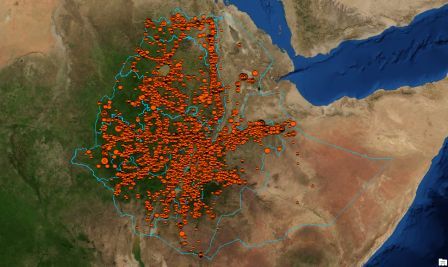
Geographic technology helps put Ethiopia on map of global health success

2013-04-23-Ethiopiamap-ARCMapSoftwareShowingFrequencyofSalesContactin2012cropped.jpg
This map, made with GIS, shows the frequency of DKT Ethiopia sales contacts in 2012.


NOTE: This originally appeared in the Huffington Post on April 24, 2013.
 
ADDIS Ababa, Ethiopia -- In just six years, DKT Ethiopia has transformed its system for tracking contraceptive sales from pins and pencils to computers and satellites and, in the process, helped create a family planning and HIV prevention success story in the Horn of Africa.

DKT Ethiopia is an affiliate of DKT International, a non-profit organization that seeks to provide couples with affordable and safe options for family planning and HIV prevention in 19 low- and middle-income countries. In Ethiopia, DKT uses social marketing to distribute three brands of condoms (and eight variants), three oral contraceptive pills, two IUDS, two injectables, one brand of emergency contraception and several other health products.

It was in 2007 that DKT Ethiopia started using GIS (Geographic Information System), a tool to display and analyze sales, finance and inventory information geographically and, particularly, to plot every one of its 30,000+ direct and indirect sales outlets. This has made an enormous difference in DKT's ability to know how its contraceptive sales are going in every corner of Ethiopia.

Before 2007, DKT used pins, pencils and Excel spread sheets to track this information, making it difficult and sometimes impossible to produce the desired information.